What One Recruit Taught Me About Preparation, Power and Survival
by Terry Waldrop
Author’s Note:
This series is told from my perspective and centers on decisions I made. I will identify myself and accept responsibility for my actions. I will not identify former athletes, coaches, administrators or others in ways that could embarrass them or drag them into events from decades ago. Some identifying details have been withheld. My purpose is to explain what happened and what I learned—not to settle old scores or throw anyone under the bus. This is the 4th installment of this series.
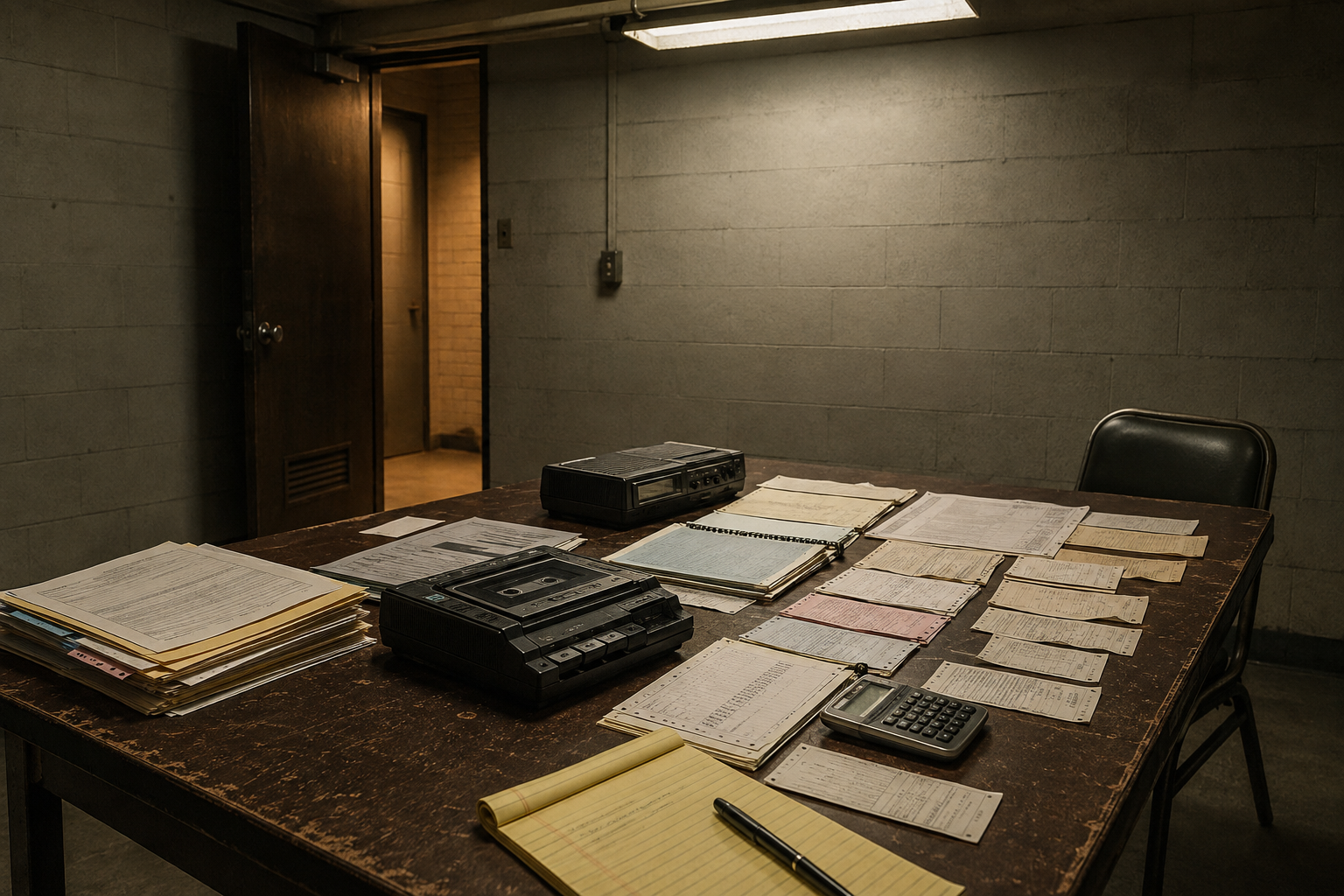
The investigator could question the explanation. He could not make the documentation disappear.
The story began with a basketball player Southeastern Louisiana University had no business signing and ended with me serving a two-game suspension for transporting a used bicycle.
In between were 39 additional college credit hours, an unexplained credit card with a $5,000 limit, an eight-month NCAA investigation, two tape recorders in a room with no air conditioning and a doctoral-program acceptance letter nobody knew about but me.
That is a lot of baggage.
I have written three separate pieces about the recruiting battle, the academic plan and the investigation because no single article could hold the entire story without becoming longer than the NCAA rulebook. But now that the individual parts have been told, the more important question is what the experience taught me about preparation, power and survival.
Those lessons followed me long after I left college basketball. I used them with attorneys, regulators, hospital surveyors, executives, politicians, boards and business partners. The people changed. The titles became more impressive. The rooms usually had better air conditioning.
The principles never changed.
Signing Him Was Only the First Victory
This was a nationally recruited junior-college player.
He was the kind of talent Southeastern Louisiana did not ordinarily sign- ever.
Programs with more money, better facilities and considerably more basketball prestige wanted him.
We got him.
That should have been the victory.
It was really the beginning of the work.
People outside college athletics often believe recruiting ends when the player signs.
People outside college athletics don’t know.
Its usually better they don’t.
With many junior-college recruits, the real question was whether that player would graduate, satisfy the transfer requirements and ever appear on your campus eligible to compete.
This player had a significant academic problem. He needed 39 additional college credit hours from multiple sources before he could enroll at Southeastern or actually anywhere for that matter.
Thirty-nine hours sounded impossible because most people heard the number and imagined a student sitting in a classroom for 39 traditional hours during one summer. That would have been impressive.
It was also not what happened.
The total came from six hours of correspondence work counted during the spring semester, 21 hours of Spanish proficiency credit, six hours of summer correspondence work through another institution and six hours of traditional summer classes at the junior college.
Six plus 21 plus six plus six.
Thirty-nine.
Spanish was his native language. The junior-college handbook allowed students to earn credit by demonstrating proficiency in material they already knew. Seven three-hour Spanish courses were listed in that handbook. He took the examinations and demonstrated that proficiency.
The opportunity was not created for him.
No administrator slipped a new rule into the book after midnight.
The policy already existed.
I found it.
Did I exploit it?
You be the judge.
That was not an academic miracle.
It was careful calculated planning based on the rules that were in place at the time and more importantly my understanding of the rules.
There is a tendency in business and athletics to label a problem impossible when what we really mean is that nobody has taken the time to work backward from the deadline, study every available option and build a plan.
Some things truly are impossible.
Others are merely unplanned.
Knowing the difference can change a career.
Paper Beats Memory
The academic plan was aggressive, but aggressive did not mean dishonest.
Every course had to count. Every grade had to be posted. Every transcript had to arrive. The junior college had to accept the outside work, award the proficiency credit and certify that the player had completed its graduation requirements.
One misunderstood policy, late grade, missing transcript or course that did not transfer could have destroyed the plan. That was why I documented almost everything.
I operated from the beginning under the assumption that we would eventually be investigated. This was a high-major-caliber player signing with a program that did not regularly beat nationally recognized schools for high-major-caliber players.
People were going to ask questions.
They did.
The NCAA wanted to know not only how he earned the hours but also how the courses were paid for. That was a fair question because courses cost money and the player did not have much.
Then, somehow, a well-known American financial institution mailed him a credit card with a $5,000 limit.
How did a junior-college player with limited resources get approved for that kind of credit line?
I did not know then.
I do not know now.
Candidly I didn’t care.
Chance also seems to favor the prepared.
To borrow from Oliver Stone's JFK, it was a mystery wrapped in a riddle inside an enigma.
But this massive mystery mystery came with receipts.
The card was in the player's name. The statements showed the charges. The receipts matched. Without that card, he could not have paid for the courses. Without the courses, he could not have graduated. Without graduation, there was no Southeastern Louisiana.
The NCAA could be suspicious of the card.
It wasn’t my problem. It was the problem of the NCAA.
What it could not do was make the documentation disappear.
That lesson stayed with me: if a decision matters, document it. If a payment may be questioned, keep the receipt. If a policy supports what you are doing, preserve the policy that existed when the decision was made.
Memory is useful until five people remember the same meeting six different ways.
Paper is less imaginative and a lot more definitive.
Power Without a Subpoena
The investigator was not some intern who had wandered into Hammond with a legal pad and a suspicious disposition. He was an attorney and an assistant director of the NCAA Enforcement Division who had worked major cases. He had seen institutional smoke and mirrors before and heard every creative explanation for money, records and eligibility that did not add up.
This dude was an assassin.
He had heads on his wall and was looking for another one.
Mine.
When he saw 39 hours, he did not assume he had found a clever academic plan. He believed he had found a major case. For approximately eight months, he interviewed people, reviewed documents, traveled, asked questions and then asked the same questions differently.
He wanted my personal bank statements and credit-card records.
The NCAA had no subpoena power over me. It could not legally compel me to surrender those records.
I had the right to refuse.
In theory.
I was told by both the NCAA and the institution that refusing could be viewed as a failure to cooperate.
They key phrasing there is “could be viewed'“
It didn’t take a law degree to understand I was being coerced.
From there, failure to provide the information could be stretched into an allegation that I was concealing information or misleading the investigation. That could become a major violation independent of whatever the investigator had originally come looking for.
Either way they were laying a trap for me that would possibly end up with me studying in a snow filled dorm room in the Rocky Mountains.
Legally, I had a choice.
Professionally, not so much.
So I reluctantly provided every statement he requested. He went through them looking for a smoking gun and in fact had a sense of euphoria about it when I turned over the folder containing the records.
To his bitter disappointment, the closest thing he found was my monthly subscription to Hugh Hefner's Playboy magazine.
It was the 1990s.
Even my vices came with a paper trail- well most of them anyway.
The joke does not change the larger point.
Power does not always come from a subpoena or a courtroom.
Sometimes it comes from an organization's ability to determine whether you can continue working in your profession.
If i had personal legal representation (which I strongly would suggest for anyone who ever finds themselves in a similar situation) they would have objected and it would have shut down that tactic quickly.
The NCAA wrote the rules, interpreted the rules, investigated possible violations and determined whether I had cooperated with its investigation.
It did not have to play fair.
It was the NCAA.
They have never played fair.
They don’t play fair to this day.
The Institution Protects the Institution
I also learned not to confuse personal loyalty with institutional protection.
My head coach supported me, and our relationship became stronger during the investigation. I have never forgotten that.
But the university had responsibilities, interests and liabilities of its own. If protecting me also protected Southeastern, I could expect support.
If sacrificing me became the easiest way to protect the institution, the execution would be swift.
Does the word expendable asset mean anything to you?
The institution protects the institution.
Always.
People may genuinely care about you and still choose the organization when your interests separate from the institution’s interests.
Loyalty matters to a point.
Loyalty however is not a business plan nor an insurance policy.
The safer approach is to align common interests.
Was it calculated?
Hell yes.
Remember instead of thinking only whether someone likes you, ask why helping you is also good for them.
Help them understand you have commonly aligned interests.
Help them understand if you fail- they perhaps will also fail.
The strongest professional relationships exist where both sides have a reason to make them work and equally motivating is where both sides potentially have something to lose.
Don’t miss that part.
Everybody Needed an Ending
By the later stages of the investigation, every one of the 39 hours could be explained.
The courses existed. The policies existed. The work had been completed. The credit had been awarded. The payments were documented.
The investigator's original theory was dead.
His investigation was not.
He had invested months of time, travel and NCAA resources.
Eventually, the NCAA brass were going to ask what all of that effort and expense had produced.
The investigator had authority, but he also had supervisors and expectations. Once I understood that, I stopped seeing him as an all-powerful figure and started seeing him as a professional inside a system.
He needed an ending.
So did I.
He needed a violation he could report.
I needed to give him one.
I also needed to give him one that my career could survive.
That was where the bicycle came in.
The player had purchased a used bicycle from another man for $50. He needed it to travel approximately three miles each way to summer school. We had the receipt.
I did not buy it.
I did not give it to him.
I transported it to him.
Under NCAA rules, that transportation was an impermissible extra benefit.
Technically, I broke the rule.
Did I know I was breaking a rule?
Yes.
During a later interview, I allowed the bicycle to enter the conversation in a way that appeared accidental.
The investigator jumped on it.
I did not deny what I had done or lie about it.
I simply gave him something he could prove and something I believed I could survive.
He had his violation.
I survived with minimal damage.
The result was a two-game suspension that the institution was more than happy to suggest and the NCAA accepted to close the case.
Both games were exhibitions.
I went to the beach for a week.
No one knew outside a handful of people.
You decide who won the round.
The NCAA came to Louisiana looking for a major academic case.
Eight months later, it left with the delivery of a used $50 bicycle.
Everybody at the table needs something.
The person who understands those needs first has an advantage.
That does not mean giving people everything they want.
It means identifying where your interests overlap and whether an acceptable resolution exists there.
The investigator needed a result.
I needed to survive.
The bicycle gave us both an acceptable resolution.
Pack the Reserve Parachute
During the investigation, I quietly applied to a doctoral program out West.
I was accepted.
Nobody knew. Not my head coach, the athletic director, my family or the NCAA.
But I knew.
If the investigation derailed my coaching career, I could leave within a day and begin building another life.
I never had to go.
The acceptance still changed how I carried myself.
Before it arrived, the NCAA appeared to control my entire future.
Afterward, it controlled only one possible version of my future.
That is a hell of a difference.
A pivot is not surrender. It is the reserve parachute you pack before takeoff and hope you never have to pull.
The reserve parachute did not make me careless or arrogant.
It made me calmer and more resolute.
I still studied the rules, preserved the records and answered the questions, but I no longer believed one investigator or one institution could erase every future available to me.
I saw the bigger clearer picture for the first time.
People have far less control over you when you know you have options.
Options do not eliminate risk.
They keep risk from owning you.
That is the takeaway.
Then Came the Injury
After all of that, the player made it to Southeastern Louisiana.
We had won the recruiting battle. We had solved the academic problem. We had accounted for every hour, explained every payment and survived the NCAA investigation.
He was exceptionally talented. In my judgment, he had the ability to become a significant professional player and possibly an NBA draft pick.
He had an exceptional Junior season.
We shared the Western Division Crown of our Conference with Samford University.
We won a conference championship.
The banner hands in the University Center to this day.
Our team picture graces the hallway.
Fast forward to the 1996-1997 season. It was packed with expectations.
Then in practice early in his senior season, he was injured.
It was significant.
The injury changed his future.
It changed ours too.
His injury and inability to perform at his previous level was the first nail in our coffin.
That injury began what would be a three-year basketball decline.
It would be dishonest to blame every loss that followed on one injury.
Programs decline for more than one reason.
But it would be equally dishonest to pretend that losing a player of that caliber did not dramatically change our trajectory.
We had beaten the academic clock.
We had survived the NCAA.
We could not negotiate with a significant injury.
Preparation is not control.
It cannot prevent every injury, eliminate every bad decision or guarantee the outcome you deserve.
What it can do is keep you from being defeated by something you should have anticipated.
That is not a small thing.
What Stayed With Me
One recruit taught me more about power and survival than a dozen management seminars ever could.
I learned that some impossible problems are simply problems nobody has planned carefully enough to solve.
I learned that documentation is paramount when everything is on the line.
I learned that an organization may be unable to compel you in court and still possess enough leverage to make refusal professionally impossible.
I learned that institutions protect themselves, that even the most intimidating person in the room has something to lose and that a survivable resolution is sometimes more valuable than winning every argument.
And I learned to pack a reserve parachute.
We signed the player.
He completed the work.
Every one of the 39 hours was accounted for.
The investigator got his bicycle.
I served my two exhibition games.
I was good at understanding the rules prior to the inquisition.
I was damn good at understanding the bylaws after.
Then the injury arrived and reminded all of us that survival and victory are not always the same thing.
The bottom line is not that preparation guarantees the outcome you want.
It does not.
Preparation gives you the best chance to recognize the opportunity, withstand the pressure and remain standing when the outcome changes.
Build the plan.
Keep the receipts.
Understand the people across the table.
And pack the reserve parachute.
Hope you never need it.
But hope is not a plan.
A plan is a plan.