Lessons from Coach Orr | Installment Two
Basketball, accountability and the world’s least likely DEA-agent bluff in desolate Oklahoma.
By Terry Waldrop
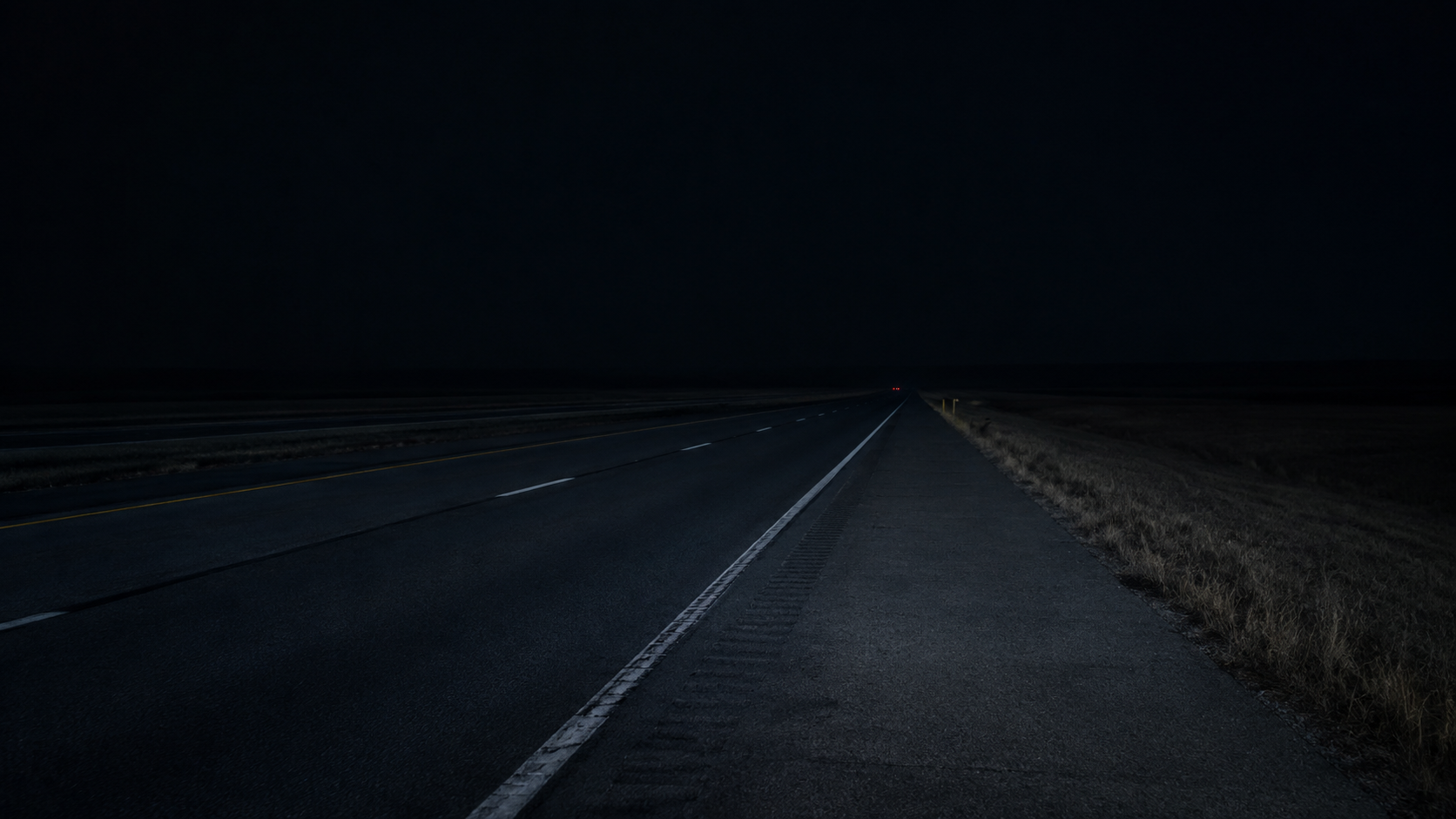
Lonely desolate highway in Central Oklahoma
The plan sounded simple.
We would play a basketball game in Oklahoma, drive through the night so our players could take a mandatory test in Gainesville, Texas, then turn around, go back to Oklahoma, play again and finally head home to Corsicana.
Simple.
It was November 1993, shortly before Thanksgiving, and I was in my second season as an assistant coach at Navarro College. We had just beaten Seminole State College, a nationally team. Under ordinary circumstances, that would have been the memorable part of the trip.
These were not ordinary circumstances.
Several of our players had to take the TASP (Texas Academic Skills Prep) test at eight o'clock the next morning to remain eligible to enroll for the spring semester.
This was a brilliant idea that every single college student in the state of Texas had to take the test, and in our case prior to the spring semester of 1994 for eligibility.
They had to pay, take the test and results really didn’t matter.
Paying the fee did.
This was 1993.
There was no online registration, no digital confirmation stored on a phone and no helpful email waiting to rescue you from your own stupidity. Each player had a paper registration, and those registrations had to arrive in Gainesville with the players.
Care to guess who was in charge of those registrations?
I had placed them in a briefcase that belonged to my father. He had received it when he retired from the Ouachita Parish school system, and I had carried it with me through every stop I had to that point in education and coaching. It had both practical and sentimental value, but on that night its most important contents were those registrations.
Before we left the hotel in Seminole, I made what I thought was one final check to ensure the briefcase had been loaded. I believed that it had, and for some reason, I even thought I had seen it when I climbed into the driver’s seat.
I accepted that impression without physically verifying it, started one of our two 15-passenger vans and headed south.
That mistake belonged to me.
A couple of hours later, somewhere south of Norman, I discovered the briefcase was not in either van. I first asked my student assistant where it was and the look on his face confirmed my fears.
The briefcase was still at the hotel in Seminole. The look of sheer horror on my face was only matched by my student assistant who at that point was riding shotgun.
The players had to be in Gainesville the next morning. Turning both vans around would jeopardize the testing schedule and create a much larger problem for the entire team including the possibility that they couldn’t register for school in the spring and as such would be in eligible.
Cell phones were just beginning to become mainstream, but in the middle of Oklahoma I was able to call Coach Orr in the other van and tell him I would meet the team in Gainesville the next morning.
He did not ask what had happened, although he most certainly knew. Coach Orr and my student assistant were going to keep the vans moving south. The registrations were my responsibility, so recovering them became my problem to solve.
I called pretty much the only person I knew in the State of Oklahoma with a car.
Darrell was a friend and assistant at the University of Oklahoma and former Navarro Assistant - and equally key- he lived in Norman.
We developed what seemed like a reasonable plan under the circumstances. The team would drop me along Interstate 35. My friend would pick me up, drive me back to Seminole to recover the briefcase and drop me off at a still undetermined location around Oklahoma City and my student assistant would come back, pick me up and be back at the hotel in time for the test the next morning.
Like I said, the plan sounded simple.
It was around 11:15PM or so that night when I stepped out of the van. I was wearing the suit I had coached in, which was appropriate clothing for a basketball game and fairly useless clothing for standing beside an interstate on a windy, 45-degree Oklahoma night in mid November.
I stepped out onto the shoulder of the Interstate. The van door closed.
Then I watched two 15-passenger vans carrying our coaches and players disappear down I-35 South.
It remains one of the loneliest sights I have ever seen.
Did I mention it was pretty cold ?
I do not know whether you have ever stood beside what is a desolate interstate in the middle of the night, but I highly recommend avoiding the experience. It was about as much fun as it sounds.
I was in the middle of nowhere with a dirt road nearby, traffic rushing past me and darkness in every direction. My ride guessed he could reach me in about 45 minutes. I was hoping he was right.
Forty-five minutes is not a particularly long time until you are freezing beside an interstate in a suit. Then it becomes an eternity. Being alone with your thoughts and being exceptionally cold on the side of a highway in the middle of the night made me thing of every serial-killer movie and television show I had ever watched as a child complete with the serial killer music vibe just to make it even more real.
The theme from the movie Halloween kept playing in my head and getting louder.
About 40 minutes into my wait, I saw three men walking down the dirt road parallel and behind the interstate and directly toward me.
The three men spotted me almost immediately. They kept their eyes on me and continued directly toward me.
They were not lost, and while they could have been traveling Bible salesman for all I knew.
Some semblance of survival instinct told me they damn sure were not collecting for the March of Dimes.
As they began to close the distance I felt like the a gazelle on a wild life documentary. We have all seen them crossing an African river while the crocodiles closed in.
We all know what comes next.
Perspective is if you are the gazelle or the crocodile.
The threat was real. It seemed even more so at the time. Like your life could end and you lead the 6 AM news real.
I believed I was about to be robbed, beaten or worse.
I also understood the cold calculated mathematics of the situation.
There were three of them and one of me.
I was not winning that fight despite having watched every Chuck Norris movie ever made.
Kris Kristofferson wrote, “Freedom’s just another word for nothin’ left to lose.”
Standing beside Interstate 35 with three men closing in- I had officially reached the gazelle being eaten by a croc portion of the evening.
Backing away wasn’t going to save me. I couldn’t win a fight against three grown men, so I did the only thing left to do.
I attacked.
Sun Tzu would have approved.
Not physically. I attacked their certainty.
I took inventory of my available weapons.
I had a ballpoint pen.
Blue.
The kind that clips onto your shirt pocket.
My guess is it was not standard Navy Seal issue.
It was a Bic.
That was not going to get it done.
I could not outrun them in dress shoes, and backing away would only confirm that I was afraid—which I was. I needed to do something they did not expect, and I needed to do it immediately.
So I charged toward them.
To this day I don’t know why or how I got the idea or how that seemed to be the best idea given the situation.
I closed the distance to about ten feet, pointed at the biggest one and started yelling with every ounce of authority I could manufacture.
“I'm DEA. There's a drug raid about to happen in this area. If you don't want to get swept up in it, you need to leave. Right now.”
I added some language intended to make my federal-agent performance more convincing. It was colorful, aggressive and probably not suitable for a leadership seminar.
I had no badge. I had no gun. I had no law-enforcement experience of any kind. I had a suit, a ballpoint pen and enough desperation to deliver the performance of my life up to that point.
The three men stopped.
For a few seconds, they did not know what to make of me.
Was I really a federal agent?
Was a drug raid actually coming?
Were they involved in the drug trade and wondering whether I might be telling the truth?
Or was I simply crazy enough that getting involved with me was no longer worth the trouble?
I did not need them to believe me all night. As it turned out, I needed them to buy my act for about 30 seconds.
While they were still trying to process the sudden appearance of the world's most unlikely DEA agent, headlights came down the road and pulled onto the shoulder of southbound I-35.
My friend had arrived.
I opened the passenger door, jumped into his car and told him to haul ass before those men figured out I was completely full of it and decided they wanted to discuss my DEA affiliation.
To this day, I do not know why that bluff worked or more appropriately it gave me a little more time. Maybe the sheer absurdity of it froze them for a moment. Maybe my suit made me look slightly more official than I had any right to look. I also believe the good Lord was watching over a young assistant coach who had gotten himself into a mess and had run out of sensible options. At that moment, bravado and stupidity had somehow become the rational choice.
We drove back to Seminole and recovered my father's briefcase from the hotel. He later dropped me at a laundromat in Oklahoma City. From a pay phone, I called our student assistant and told him where to find me.
My friend who rescued me deserves a lot of credit. Not many people you can call in the middle of the night and they come pick you up no questions asked. Coaches get that. My student assistant also deserves a lot of credit. He had driven one of the vans to Gainesville. Then he drove back to Oklahoma City to pick me up. We remain friends to this day.
We arrived around 7:30 Sunday morning. The players were eating breakfast and most had zero clue about anything going wrong and as players tend to do - they didn’t worry about it. The team was scheduled to leave for the testing center at 7:45.
I was still wearing the same suit albeit it wrinkled and a bit gamey.
I had not slept. I had not showered. I probably looked as if I had spent the night being dragged behind one of those vans instead of riding in it.
Believe me, it could have been much worse.
Coach looked at me.
He knew something had happened. One glance told him that much.
He did not ask.
Coach could say plenty when plenty needed to be said. But he also understood when a man had already received the lesson. I was standing there exhausted, holding the briefcase I had failed to verify was loaded. The players were ready. The schedule had been protected. My mistake had been corrected.
I would not make the same one again.
There was no need for a speech. His lesson was noted.
The players took the TASP test. We loaded the vans, drove back to Seminole, played at four o'clock and won again. Then we drove home to Corsicana and arrived around midnight.
For years, the part of that story people would naturally remember is the DEA bluff.
I understand why.
Pretending to be a federal agent while armed with a ballpoint pen is not standard material in a coaching manual.
Then again, it may be more standard in junior-college basketball lore than people realize.
My junior-college guys will understand that.
The rest of you- not so much.
But that was not the lesson.
The lesson began hours earlier when I failed to personally ensure that the briefcase was on board.
Years later, I heard someone use the phrase “trust but verify.”
Words to live by.
The registrations were my job and mine alone. I was 100 percent accountable for not having them. Zero excuses. I caused the problem, so it was on me to remedy the situation.
We saw a problem, and we resolved it.
The in-between makes a great story, but the bottom line is that the problem was handled.
When the mistake became clear, Coach Orr did not turn the entire team around so everyone could share the consequences. He kept the mission moving. I stayed behind and fixed the problem I had allowed to happen.
The players reached Gainesville. They took the test. We returned to Seminole. We won the game. My mistake cost me a long, cold and occasionally terrifying night, but it did not become the team's excuse.
That was the standard.
Own the responsibility. Correct the mistake. Do not make everyone else carry the weight of your failure.
Trust your people. Give them responsibility. Let them do their jobs. Empower them to own and correct their mistakes.
But when the outcome still belongs to you, verify the things that cannot be left to chance.
I learned that lesson somewhere beside Interstate 35 in rural Oklahoma, freezing in a suit, holding a blue ballpoint pen and impersonating the least qualified DEA agent in American history.
The gazelle lived to run another day.