How Did a Junior-College Player Earn 39 Credits Before Fall? The NCAA Wanted to Know, Too.
By Terry Waldrop
August 20, 2026
Author’s Note:
This series is told from my perspective and centers on decisions I made. I will identify myself and accept responsibility for my actions. I will not identify former athletes, coaches, administrators or others in ways that could embarrass them or drag them into events from decades ago. Some identifying details have been withheld. My purpose is to explain what happened and what I learned—not to settle old scores or throw anyone under the bus.
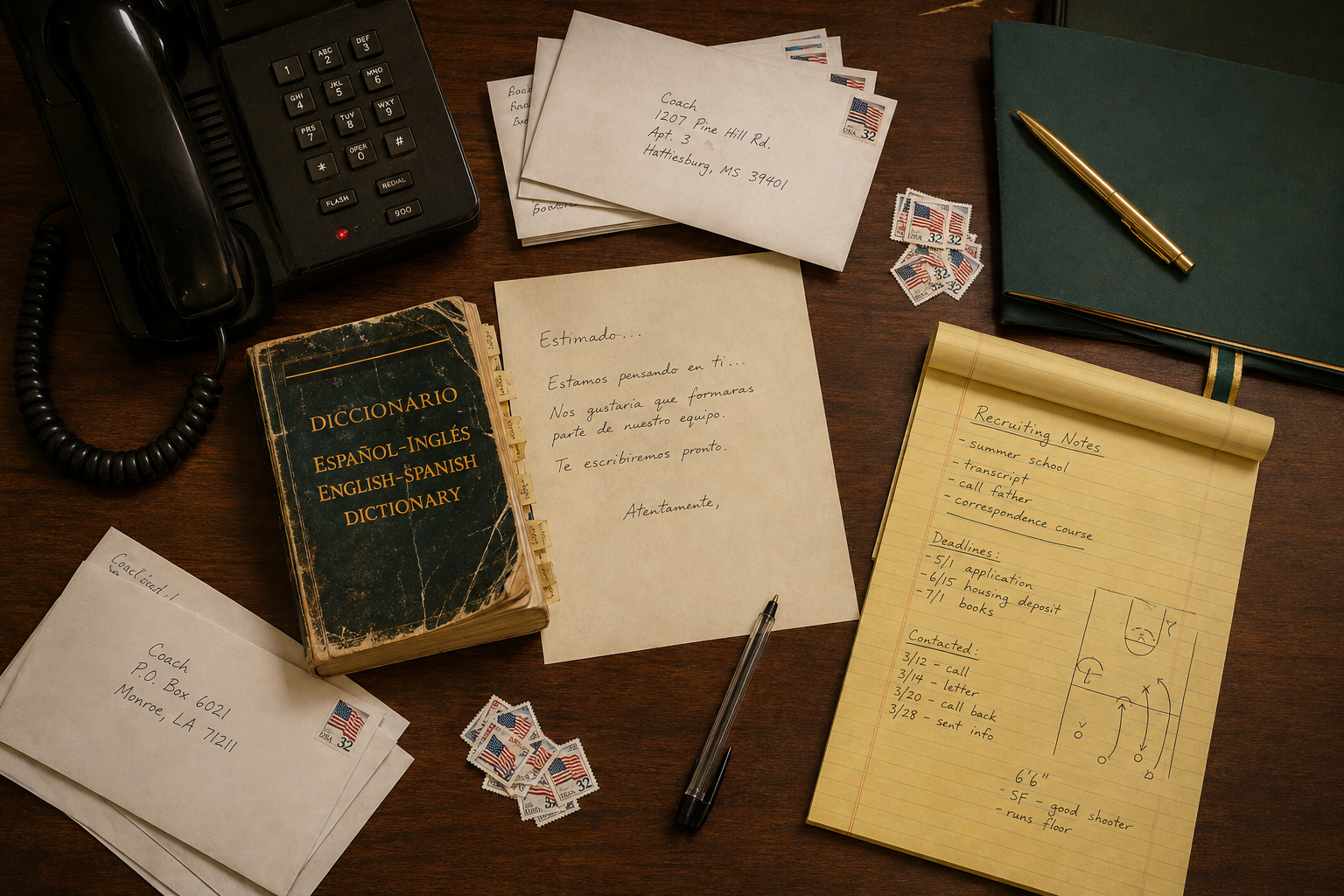
Recruiting in 1996: no email, no text messages and no Google Translate—just an 800 number, a Spanish-English dictionary and a whole lot of stamps.
The NCAA investigator laid out the player’s academic record and pointed to one number.
Thirty-nine.
The player had accumulated 39 additional college credit hours between signing with Southeastern Louisiana University in the spring and enrolling in the fall.
There were 5 separate transcripts.
The investigator had one obvious question:
How was that possible?
Fair question.
A normal full-time student might complete approximately 30 hours during an entire academic year. On paper, it looked as if this player had crammed more than a year of college into one summer.
He had not.
The number was accurate. What it appeared to mean was not.
Six plus 21 plus six plus six.
That was the answer.
But before I explain the math, I need to explain the player—and why Southeastern Louisiana ever had a chance to sign him.
Before the Thirty-Nine Hours
In July 1994, approximately 200 junior-college basketball players gathered at Oral Roberts University in Tulsa for the Jerry Mullins event.
At the time, it was the gold standard for junior-college recruiting. Every serious college recruiter in the country had it marked on the calendar.
If you wanted junior-college players, you went to Tulsa.
I had registered three Navarro College players for the event back in March. By the time the camp arrived, however, my circumstances had changed.
One week earlier, I had accepted a job as an assistant coach at Southeastern Louisiana.
That meant I had to tell the Navarro players I was leaving.
I had recruited them, coached them and invested countless hours in their futures. They trusted me. Telling them I was leaving was not easy.
Coaching is full of decisions like that. You ask players to trust you, and then an opportunity comes along that may be better for your career and your family. Sometimes taking the next step means leaving people you care about.
It would not be the last time I had to make that decision.
I arrived in Tulsa in an unusual position. I had registered those players as a Navarro assistant. Now I was watching them—and recruiting them—as a Division I assistant at Southeastern Louisiana.
All three could play.
In fact, they were among the best players at the camp.
I was pretty proud.
Three Players and a Recruiting Circus
The first was a crafty 6-foot-3 point guard from Louisiana. He had been Mr. Basketball in the state and won a state championship. He could score, defend and create opportunities for other people. He was a legitimate mid-major Division I guard and went on to win an ESPY during his first year at an NCAA Division I school.
The second was another 6-foot-3 guard. He was originally from Latin America and had come to Navarro through New York City.
He may have been the best off-the-dribble guard I ever coached. His double crossover was lethal. He was powerful, explosive and creative with the ball. He could get anywhere he wanted on the floor. Once he got there, he could finish or make the next play.
He was a high-major player with an enormous upside.
The third was an international 6-foot-9 center who had been at Navarro when I arrived in 1992. He was still developing, but his combination of size, speed and athleticism was impossible to ignore. Those qualities eventually took him to the NBA and a long professional career.
He and I were exceptionally close then, and we remain close today.
All three made the first all-star game at the Mullins event.
The center spent the week dunking everything in sight, blocking shots and running the floor like a much smaller player. His recruitment went completely off the charts.
It got ridiculous.
I was offered jobs by multiple schools to bring one, two or all three players with me.
I have to be honest:
I thought about it.
A lot.
That damn weakness of mine—loyalty to my coach—crept in again.
I really didn’t know John Lyles that well at that point but still he had given me a chance.
Damn.
Lion up.
Nearly every major program in the country wanted the center. Even blue bloods that normally stayed away from junior-college players made an exception. He eventually chose a Big East program and helped take it to within a whisper of the Final Four. That recruitment story, from my perspective, is another story for another day.
We were not competing against schools that looked like Southeastern Louisiana. We were recruiting against nationally recognized programs with bigger budgets, better facilities, a hell of a lot more tradition and, shall we say, resources.
The guard from New York was a different story.
He was also a high-major talent, but I had recruited him and coached him. I knew his father, and I understood his academic situation better than anyone else recruiting him.
That was our advantage.
We were not going to win because Southeastern Louisiana had the bigger name. We did not.
If we won, it would be because the player and his father trusted me.
Talent was not the issue.
Junior-college graduation was.
Each of the three players had spent more than the traditional four semesters in junior college. By the time their two seasons of basketball eligibility were finished, all three still needed additional academic work before they could graduate, enroll and compete at a Division I university.
They needed summer school.
A lot of it.
A whole lot of it.
That was the dividing line in junior-college recruiting. Plenty of coaches could recognize talent. Many could convince a good player to sign a scholarship agreement.
The hard part was getting him onto campus eligible in the fall.
The really hard part was doing it inside an NCAA rulebook that seemed to grow by the week.
Recruiting Before Email
I stayed in almost daily contact with the center and the guard in some form or fashion.
This was before email, text messages and social media. NCAA rules limited how often we could call a prospect, so I had an 800 number that allowed prospects to call me whenever they wanted.
And they did.
There is another story about that 800 number. I will save it for another day.
There was no rule preventing us from sending mail to recruits.
Every day.
Regular snail mail.
Write the letter. Address the envelope. Put a stamp on it. Drop it at the post office.
Then do it again tomorrow.
I wrote each player an additional letter in Spanish. These were not form letters with a different name typed across the top. They were handwritten.
Did I mention I did not speak Spanish?
I owned a dog-eared Spanish-English dictionary that became the most-used book in my house. There was no Google Translate or internet conversion.
There was Waldrop, a dictionary, a strong will and cases of blue felt-tip pens.
Recruiting in 1996: no email, no text messages and no Google Translate—just an 800 number, a Spanish-English dictionary and a whole lot of stamps.
At one point, I broke my left thumb while helping at my oldest son’s fourth-grade football practice. It had to be reset and placed in a large cast.
I am left-handed.
That was inconvenient because recruiting did not stop while my thumb healed. I was sending somewhere between 50 and 100 recruiting letters most days, and I wrote them myself.
All of them.
So I learned to write with my right hand.
It was not pretty, but the letters went out.
Every day.
Without fail.
Those letters strengthened the relationships. I was playing the cards I had.
But signing him was only half the job.
The other half was figuring out how he could complete enough legitimate academic work to graduate from junior college and arrive at Southeastern eligible.
The Final Recruiting Battle
The battle for the guard was intense.
Every program recruiting him understood the academic challenge. He needed a tremendous amount of work to graduate and become eligible at the Division I level.
A lot of schools eventually dropped out.
They liked the player.
They did not like the transcript.
One major program stayed in. It was led by one of the most recognizable coaches in college basketball and had extensive experience recruiting junior-college players. They knew the eligibility process and had a track record far superior to mine.
They had more resources, a bigger name and considerably more tradition.
In the end, it came down to them and us.
They had almost every institutional advantage.
I had my relationship with the player and his father.
His father was not simply looking for a basketball scholarship. He wanted someone who would take responsibility for helping his son graduate, become eligible and make the transition to a four-year university.
He wanted his son to earn a four-year degree.
I loved that about the dad.
He saw a bigger picture even if I didn’t at the time.
There was no alternative.
I told him I would do everything I could to make that happen.
Academics and my personal relationship were my only plays.
The other program told the player it appeared on national television approximately 30 times a year. If he wanted professional exposure, he could not do much better than that.
They were right. I always respected the fact that they did not lie to him. I am not sure they ever mentioned academics.
A few things broke our way late. Call it good fortune, luck or whatever you choose.
He signed with Southeastern Louisiana on the first day of the spring signing period in April 1996.
There was no time for a victory lap.
He enrolled in correspondence courses the next day.
Like, the next day.
That was part of the plan.
I had won the recruiting battle.
Now I had to get him eligible.
Six Plus Twenty-One Plus Six Plus Six
The NCAA did not begin an eight-month investigation because of a bicycle.
Not initially, anyway.
The first question was how this player became eligible.
When all the academic work was completed, his record showed 39 additional college credit hours from multiple schools.
That got the NCAA’s attention.
But he did not take 39 hours of summer classes.
Here is where the hours came from:
Six hours of correspondence work counted during the spring semester and completed in late May.
Twenty-one hours earned through Spanish-language proficiency examinations.
Six hours of summer correspondence work completed through another institution.
Six hours of traditional summer classes completed at the junior college.
Six plus 21 plus six plus six.
Thirty-nine.
It looked complicated.
It really was not.
The First Six Hours
The first six hours came through correspondence courses offered by a four-year university several states away.
The player enrolled the day after he signed with Southeastern.
Were the registration forms already filled out and sitting there with a stamp, waiting for him to put them in the mail?
What do you think?
Correspondence courses were the 1990s version of online classes, except nothing happened instantly. The student received course materials, completed assignments, put them in an envelope and mailed them to the instructor. Then he waited for the work to be graded and returned.
While one assignment was being graded, he worked on the next one.
Caveman stuff by today’s standards, but it was legitimate college work. There were instructors, assignments, grades and documentation.
Under that university’s calendar and policies, those six hours counted as spring-semester credit.
They were not part of his summer academic load.
That mattered.
Again, part of the plan.
Twenty-One Hours of Spanish
The next 21 hours came from understanding the player and reading the academic handbook.
Spanish was his native language.
The junior college handbook listed every course the institution offered, including seven different three-hour Spanish courses.
Seven courses.
The seven courses included six hours each of basic Spanish, intermediate Spanish and Spanish literature, plus three hours of Spanish composition and conversation.
Twenty-one hours.
The player did not sit through seven Spanish classes during the summer. He demonstrated that he already knew the material those classes were designed to teach.
Colleges award proficiency credit in many subjects. If a student can prove he already knows the material, he may receive credit without sitting through an introductory class that teaches him something he has known his entire life.
This option was not invented for him.
It was already in the handbook.
I found it and understood how it fit into his degree plan.
He applied to take proficiency examinations for seven—yes, seven—three-hour Spanish courses.
He completed the exams over two days. Each lasted approximately 30 minutes.
Spanish was the language he had spoken his entire life.
Cake.
Those hours also satisfied 21 of the 24 residency hours he needed to graduate from that junior college.
He needed three more residency hours.
Good thing he was taking six.
Trust the plan.
The Final Twelve Hours
That left 12 hours to complete during the summer, but only six were traditional junior-college classes.
The player was also enrolled in six hours of correspondence work through another institution. He completed those courses while attending summer school at the junior college.
There was no rule against it.
I checked.
That left six traditional summer hours at the junior college. He had to attend class, complete the work, take the examinations and pass both courses before the deadline for enrolling at Southeastern.
There was no margin for error.
Did I mention he was riding a bicycle three miles each way in the Mississippi summer?
I almost forgot that part.
Now you can see how 39 hours were possible.
Thirty-nine hours of traditional classroom work during one summer would have been absurd.
Six hours of spring correspondence work, 21 hours of Spanish proficiency credit, six hours of summer correspondence work and six hours of traditional summer school were not absurd.
Aggressive?
Absolutely.
Impossible?
Not even close.
How Was It Paid For?
There was still one problem.
Courses cost money.
Living expenses cost money.
Food costs money.
The investigator wanted to know who paid the bills.
Fair question.
Somehow—inexplicably—a well-known American financial institution mailed the player a credit card with a $5,000 limit.
How did a junior-college player with limited resources get approved for a $5,000 line of credit?
I had no idea then.
I have no idea now.
I didn’t ask.
I didn’t care.
To borrow a line from Oliver Stone's JFK, it was a mystery wrapped in a riddle inside an enigma.
But unlike most mysteries, this one came with receipts.
The card was real. It was in his name. The statements showed the charges. The receipts matched. The paper trail was there.
Did the credit card earn a single hour for him?
No.
He still had to complete the assignments, pass the examinations and satisfy every academic requirement.
Would he have become eligible without it?
No.
No credit card, no way to legally account for the courses.
No courses, no graduation.
No graduation, no Southeastern Louisiana.
Sometimes the difference between impossible and possible is an academic handbook. Sometimes it is a credit card arriving in the mail for reasons nobody can explain.
It Was a Plan
I worked backward from the date the player needed to enroll at Southeastern and built a plan that gave him a chance to get there.
Nothing happened by accident.
Every course had to count. Every credit had to be accepted. Every grade had to be posted. The proficiency credit had to appear on the transcript. The junior college had to recognize the outside work and certify that he had completed its graduation requirements.
One mistake could have killed the entire plan.
One course that did not transfer.
One grade posted too late.
One transcript that did not arrive.
One requirement we misunderstood.
Any one of those could have kept him off our campus.
That was why I documented almost everything. From the beginning, I operated under the assumption that the NCAA would eventually ask questions.
This was a high-major player signing with a program that did not normally beat nationally recognized schools for high-major players.
People were going to notice.
They did.
Was the plan calculated?
Of course it was.
I was not throwing courses against a wall and hoping enough of them stuck. I knew what the player needed and how little room we had for error.
It was not an academic miracle.
It was a plan.
A really good one.
I am not comparing it to the Normandy invasion, but for a twentysomething aspiring college basketball coach, it was pretty creative and ruthlessly efficient.
The Investigator and Me
The investigator and I developed one of the strangest professional relationships I have ever had.
He was no amateur. He was an attorney and an assistant director of the NCAA Enforcement Division who had worked major investigations. He had seen every version of institutional smoke and mirrors and heard every creative explanation for records, money and eligibility that did not add up.
He was suspicious by nature because experience had trained him to be.
Make no mistake: this dude was a damn shark.
He already had some big heads on his wall and was looking for another one.
Mine.
Southeastern Louisiana was not unfamiliar territory to NCAA enforcement, either. In 1989, its men’s basketball program had been placed on five years’ probation for repeated NCAA rules violations. The NCAA already knew the road to Hammond.
He did not see 39 hours and assume there was an innocent explanation. He believed there was a major case buried underneath them.
He intended to find it.
I intended to account for every hour.
The NCAA had no subpoena power over me. It could not legally compel me to turn over my personal bank statements, credit-card records or other private financial information.
I had the right to refuse.
In theory.
In practice, I was told that refusing could be viewed as failing to cooperate. That refusal could then be stretched into an accusation that I was concealing information or misleading the investigation—a major violation independent of whatever they had originally come looking for.
That could cost me my job.
That was how the choice was communicated to me.
It wasn’t a request.
Legally, I could refuse.
Professionally, not so much.
So I reluctantly provided every statement the investigator requested.
He went through them looking for and honestly expecting a smoking gun.
To his obvious disappointment, the closest thing he found was my monthly subscription to Hugh Hefner’s Playboy magazine.
It was the 1990s.
Even my vices came with a paper trail.
At times, we were highly adversarial. At other times, we were almost friendly. We developed a running banter that seems strange even now, considering he was investigating me and actively trying to end my career.
In some ways, I became his counselor.
Again, quite odd.
During lighter moments, he told me about other investigations. One story has always stayed with me.
He had requested specific academic records from another university. This was before institutions stored everything electronically. Transcripts, ACT results and other academic records were generally kept on paper in filing cabinets or storage rooms.
University officials assured him the records would be ready the next day.
When he returned, they told him there had been a break-in overnight.
Not simply a break-in somewhere on campus.
Someone had entered the facility where the academic records were stored, opened the correct filing cabinet and gone directly to the exact drawer containing the documents he had requested.
Those files—and apparently only those files—were missing.
The police chief told him there were no leads.
Apparently, the burglar had a remarkable understanding of the university’s filing system.
I understood the South and, more importantly, the school.
He was getting on the job training.
It blew his mind that this was the explanation they expected him to accept.
I almost felt bad for the guy.
Almost.
That story helped me understand why his suspicion ran so deep. He had dealt with institutions where important records developed legs and walked away.
Ours did not disappear.
To his chagrin, we almost had too many.
He did not like how aggressively I used the academic rules to my advantage, but he could follow exactly what happened.
That became important.
When the Investigation Changed
The investigator did not know the details when he first saw 39 hours. He saw a number that appeared impossible and began asking questions.
Then he got into the substance of it.
The courses existed. The work was completed. The proficiency examinations were allowed under the junior college’s policies. The school awarded the credit, accepted the outside coursework and certified the player for graduation.
The number looked impossible.
The explanation was not.
By the time the investigator understood that, however, he was already deep into the case. There had been interviews, documents, travel, institutional disruption and a considerable investment of time.
The original theory was off the table.
It was dead in the water.
He knew it.
The investigation did not end.
It changed direction.
If the credits were legitimate, perhaps something surrounding the process violated NCAA rules.
Who arranged the courses?
Who paid the tuition?
Who found the housing?
Who provided transportation?
Who made the telephone calls?
Who moved the player from one place to another?
The academic result was no longer the center of the investigation.
The process became the case.
I did not blame him for questioning the 39 hours. I would have questioned them too.
But he could trace every one of them. He could review the courses, assignments, grades, proficiency examinations and university policies.
The paperwork did not disappear.
The player completed the work, received the credit, graduated from junior college and arrived at Southeastern Louisiana eligible.
Was the plan aggressive?
Hell yes.
But aggressive planning was not a violation. Reading the handbook was not illegal.
The NCAA rulebook is written by attorneys for attorneys.
There is built-in deniability and plenty of gray area—by design.
Understanding the rules at least equally as well as the people lined up across the table for you was crucial.
Using the rules to my advantage against the NCAA attorney looking for a scalp?
Satisfying? Yes.
More importantly?
Invaluable.
I learned something during those months that followed me into every compliance meeting, hospital survey and institutional crisis for the rest of my career:
If a result looks too good to be true, somebody will eventually ask how you did it.
You had better be able to show them.
I could.
Every course.
Every grade.
Every policy.
Every payment.
Every one of the 39 hours.
Accounted for.
But proving those hours were entirely possible did not end the investigation. It simply sent the investigator searching around the edges for something else.
Eventually, he found the bicycle or as I told you in the previous episode- I gave him a bicycle.
The NCAA came to Louisiana asking how a junior-college player earned 39 credit hours.
As far as I know, the investigator never discovered who broke into the filing cabinet at the other school. Some mysteries stay mysteries I guess.
He came to Louisiana expecting another trophy for the wall.
Eight months later, he left with an unsolved burglary and a $50 bicycle.