
I Gave the NCAA a Bicycle
By Terry Waldrop
Author’s Note: This series is told from my perspective. I will put my own name on my decisions and accept responsibility for them. I will not identify former athletes, coaches, administrators or others simply to embarrass them or cast them in a bad light. Some identifying details will be left out for that reason. My purpose is to explain what happened and what I learned, not to settle old scores or throw anyone under the bus.
Part 2 of the recruiting series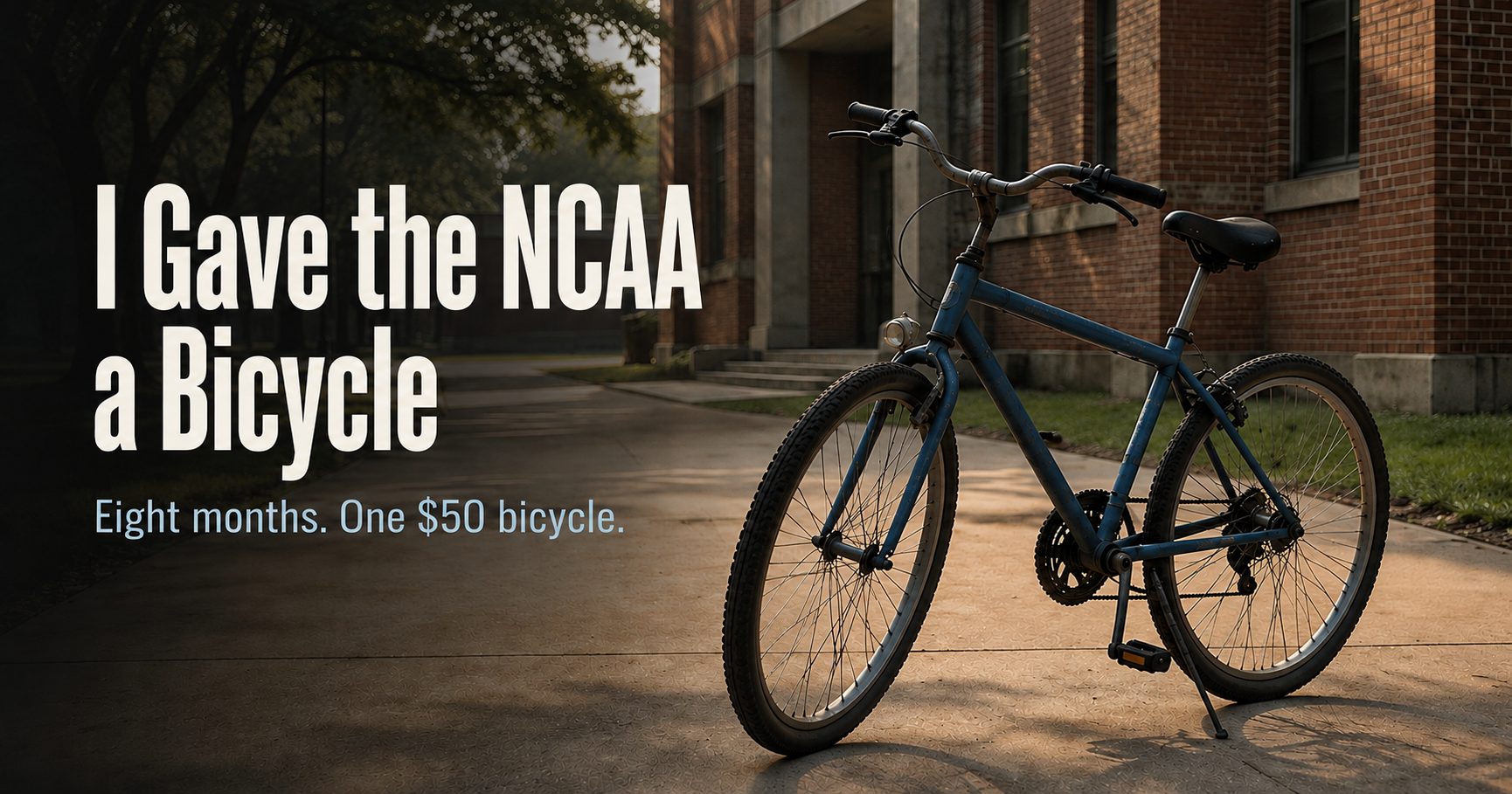
After approximately eight months of interviews, travel, attorneys, tape recorders and NCAA investigative muscle, they finally got me.
My crime?
I transported a used bicycle.
Let me be precise because the details matter.
I did not buy the bicycle for the prospective student-athlete. I did not give it to him. He paid another man $50 for it.
I transported the bicycle so he could ride approximately three miles each way to summer school.
That was it.
Not exactly Godfather stuff.
In NCAA terms, the delivery was treated as a secondary recruiting violation involving an impermissible benefit to a prospective student-athlete. Because he had not yet enrolled full time at Southeastern Louisiana University, the case fell under the recruiting rules in Bylaw 13, not the extra-benefit rules that generally applied to enrolled student-athletes.
The university proposed a two-game suspension for me and required me to attend compliance seminars. The NCAA accepted the resolution. Both games were exhibitions, almost no one outside the program knew about it, and my coaching career continued.
The player was required to donate $20 to the Boys & Girls Club before his eligibility was restored. That was the NCAA's estimated value of my bicycle-delivery service.
Twenty dollars.
The donation was made, the paperwork was completed and the academic integrity of college basketball survived another day.
The more interesting story is how the bicycle became the investigator's victory, why I decided to give him that victory and what the entire episode revealed about the academic machinery operating beneath college basketball during that era.
To understand the bicycle, you first have to understand the world around it.
The Proposition 48 Era
Before NIL, cheating in college athletics was usually portrayed as a bag of cash being dropped into a recruit's living room or handed to some shady middleman.
Those cases existed. They always have, and they probably always will.
But much of the rule-breaking I saw was not that dramatic. It involved far less money, considerably more paperwork and circumstances that otherwise respectable people could rationalize without much trouble.
A great deal of it involved academics.
People still referred to it as the Proposition 48 era, although the NCAA's Proposition 16 standards were being phased in by 1996. The exact formula changed during that transition, but the basic issue remained the same: a prospective student-athlete needed the required high-school core courses and a qualifying combination of grade-point average and ACT or SAT score to meet Division I initial-eligibility standards.
Many exceptionally talented players failed to meet those standards.
That did not necessarily mean they lacked intelligence. More often, it meant they were academically unprepared for what the NCAA required.
There is a difference.
Some had attended underperforming schools. Some had been passed from one grade to the next. Some had received years of attention for what they could do with a basketball while far less attention was paid to what was happening in the classroom.
Then the NCAA eligibility standards stopped them at the Division I door.
For many, the most practical and in fact only alternative was junior college.
The theory was simple. The player would attend a two-year college, improve academically, earn the necessary credits, graduate and transfer to a four-year institution.
On paper, it made sense.
In practice, very little about it was simple.
The rules also affected programs differently. A national power could miss on one academically questionable recruit and move to the next highly rated player. A lower-level Division I program might see that same recruit as good enough to change the program and perhaps save a coach's job.
That was the reality.
Eligibility Was Not the Same as Education
Many of these players arrived at junior college carrying academic deficiencies that had accumulated over most of their lives.
Their high-school records, standardized-test scores or college-placement results often showed that they needed remedial English or mathematics before they were ready for college-level work.
I understand that personally.
I had to take remedial mathematics when I entered college. I remember it well, and I was not trying to become a Division I basketball player at the same time.
Remedial courses served an important purpose. A student who lacked the proper foundation needed that instruction before being dropped into more advanced classes.
But those courses created another problem for a junior-college athlete trying to graduate and transfer within two years.
They required tuition, work and, most importantly, time. They were often prerequisites for the college-level courses a player eventually needed, but they frequently did not count as transferable degree credit.
A player might spend six or twelve credit hours completing remedial work before he was permitted to begin some of the courses necessary for graduation and transfer.
Meanwhile, the clock kept running.
At the Division I level, the five-year clock generally began when the athlete first enrolled full time at any college. He had five calendar years to play four seasons. A redshirt year could give him more time to develop academically, but it did not stop that clock.
Once a year was gone, whether because of injury or academic preparation, it was gone.
Within that window, a junior-college player might have to address years of academic deficiencies, complete remedial requirements, pass college-level courses, earn an associate degree and accumulate enough transferable credit to satisfy the four-year university.
He also had to practice, lift weights, travel and play a full college basketball schedule. If he completed the process, he transferred to a Division I university and was immediately expected to handle more advanced work. Now in fairness most NCAA Division I institutions had an academic staff to assist players in that transition. Junior Colleges had an assistant coach who washed clothes, swept the floor, recruited for next season, managed current players and was a personal tutor for 14 separate players.
Junior College was challenging enough for a well-prepared student.
For someone who was not prepared, it could become nearly impossible.
Sometimes the system worked exactly as intended. Dedicated teachers, counselors and coaches helped players mature academically. Young men learned how to study, completed legitimate coursework and earned degrees that changed their lives.
I witnessed many of those stories. I helped create some of them.
But sometimes the transcript improved much faster than the student did.
The NCAA could count transferable hours. It could calculate a grade-point average. It could confirm that a degree had been awarded.
What it could not always determine was whether the player had received an education or had simply been moved successfully through the eligibility process.
Those were not always the same thing.
Christmas Was Not the Time for Miracles
For many junior-college recruits, summer school was where the transfer attempt lived or died.
Once a player completed his final basketball season, he might still need several courses, or a ton of them, to graduate and satisfy the requirements of the Division I school that had signed him.
Those requirements had to be completed before he enrolled there in the fall.
The work had to be done during the summer or if planned correctly would start in the spring immediately prior.
If everyone recognized the problem early enough, some of the work could begin during the player's final spring semester through correspondence courses, the prehistoric ancestors of today's online classes. A student completed the work, put it in an envelope and mailed it to the instructor. Then everyone waited.
Rinse and repeat.
Caveman stuff, really.
There was no clicking “submit” at 11:58 p.m. Everything required planning, postage and patience.
Christmas was not the time for academic miracles.
Summertime was.
Most junior colleges I knew, worked with or recruited from did not have the financial resources to pay for their athletes to attend summer school.
The tuition was not necessarily outrageous. But when nobody had money, even a modest bill became a major obstacle.
We used to say something similar about geography when I coached in junior college. We were approximately 40 miles from Dallas.
That sounded close.
But if you did not have a car, you might as well have been 400 miles from Dallas. The distance did not matter because you had no way to cover it.
Summer school worked the same way.
An $800 tuition bill might not sound insurmountable to someone earning a steady paycheck. To a struggling player, his family and a junior-college athletic department operating on fumes, it might as well have been $8,000.
The player needed the courses. His junior college might not offer them or might not have the money to pay for them.
At that point, the problem usually shifted to the four-year school that had signed him. Division I coaches' jobs depended on having talented players arrive eligible to compete.
And the clock was running.
It was always running.
Summer School Had Its Own Recruiting Network
Coaches across the country knew which junior colleges offered summer classes.
They knew which schools had affordable tuition and housing. They knew where particular courses were available and which institutions accepted students who were coming only for the summer.
Summer school had its own informal recruiting network.
Finding a school was only the beginning.
The courses had to match the player's academic needs. They had to transfer back to his home institution, satisfy the requirements of his degree program and ultimately be accepted by the college awarding the degree.
A player might need one particular mathematics class, an English course and a laboratory science.
Finding three courses was easy.
Finding the correct three courses during the same summer term, at a school the player could attend and afford, with credits another institution would accept, was not nearly as simple.
Every transcript was its own puzzle.
Someone had to know which courses the player had completed, which ones he still needed and what would transfer. Then someone had to work backward from the date he needed to report to the four-year school.
After that, you had to stay on top of him.
Did he attend and complete the work?
Was the degree awarded and when?
One missed step could wreck the entire plan.
It required knowledge, relationships and constant attention.
I was really good at it.
And after all the academic pieces were assembled, someone still had to find the money.
What Cheating Often Looked Like
When people hear that a college program cheated, they imagine somebody dropping $50,000 or $100,000 into a recruit's living room or handing it to a middleman.
Again, that happened.
But much of the rule-breaking I personally knew about was considerably less glamorous.
Someone paid an $800 summer-school bill. Depending on the number of courses, it might reach $1,000.
Someone sent a player's family $250 after the electricity had been disconnected.
Someone bought a bus ticket so a player could get home.
Someone covered rent, food or transportation so a player could remain in school long enough to complete the semester.
Most situations within my personal knowledge involved far less money than you would ever imagine.
Did the smaller amount make it permissible under NCAA rules?
No.
Did an understandable motive erase the violation?
No.
Rules cannot function if every coach decides which ones apply according to his own sense of fairness. Providing an unauthorized benefit could also create a competitive advantage, even when the amount was small and the motive appeared compassionate.
I understood that then, and I understand it now.
Coaches want a competitive advantage. So do businesses, hospitals, universities and almost every other organization operating in a competitive environment.
The real question is how that advantage is gained.
But context still matters.
Is there a moral difference between paying a recruit $100,000 to sign with your school and finding $800 so an academically struggling young man can complete the courses necessary to graduate?
Under the rules of that era, both could be impermissible recruiting inducements.
Common sense does not require us to pretend they carried the same moral weight.
That was the world surrounding my bicycle violation.
The player needed to attend summer school. He lived approximately three miles from campus without reliable transportation. He bought a used bicycle from another man for $50.
We had the receipt, and we eventually gave it to the NCAA.
Why did we have it?
Because from the beginning, I operated under the assumption that we might eventually be investigated.
This was not an ordinary recruit for our program. He was nationally known and talented enough to attract far more prominent schools. People were going to notice if he signed with Southeastern Louisiana.
I had recruited and coached him in junior college. I had a relationship with him that other coaches did not have, and that relationship mattered.
I knew questions would be asked, so I documented everything I could.
I documented the bicycle.
The same system that desperately needed him to attend class determined that helping him actually get to class constituted an impermissible recruiting benefit.
Technically, the NCAA was correct.
I broke the rule.
The Investigator Needed an Ending
By the later stages of the investigation, one thing had become clear.
The investigator believed or more appropriately hoped he was looking at a major recruiting and academic case.
He had conducted interviews, reviewed records, followed leads and spent months trying to reconstruct events that had occurred the prior summer.
I am not claiming the NCAA had no reason to ask questions.
I had broken a rule.
The bicycle would eventually become the violation it could prove.
But the investigator was looking for something much larger than a bicycle.
He had theories.
He had suspicions.
What he did not have was enough evidence to support the case he believed was there.
That distinction mattered.
He did not need to believe something had happened.
He needed to prove it.
The prospective student-athlete never waivered under threat and promise by the investigator.
I always respected that.
Other people who knew different pieces of the process did not provide the investigator with the case he wanted either.
He was stonewalled.
He had spent a great deal of time and money.
By late summer, his frustration was obvious.
I started looking at the situation from his perspective.
Eventually, he would have to return to the NCAA enforcement staff and explain what the investigation had accomplished. There had been months of interviews, travel, institutional disruption and legal expense.
What did he have to show for it?
Not much.
The questioning was also becoming more focused on possible contradictions. If the investigator could establish that I had provided false or misleading information, a manageable rules case could become far more serious.
That was the trap I had to avoid.
After months of sitting across from each other, the investigator and I suddenly had something in common.
We both needed an ending.
He needed a violation he could prove.
I needed something I could survive.
I took a calculated risk.
I decided to give the investigator something.
A bicycle.
I Made It Look Like a Mistake
During another interview, I allowed the bicycle to enter the conversation.
I did not announce it dramatically. I made it appear that exhaustion and frustration had caused me to reveal something I had not intended to say.
Then I reacted as though I had immediately realized my mistake.
The investigator jumped on it like a starving lion.
His questions became sharper. The energy in the room changed.
After months of searching, he finally had something.
And I became appropriately horrified.
I did not deny transporting the bicycle. Once I acknowledged it, lying about it would have created a far more serious problem than the delivery itself.
Instead, I became the frightened young assistant coach who had suddenly realized he might have admitted to an NCAA violation.
Inside, I knew exactly what I had done.
I had given him a win.
Not the case he originally came looking for.
Not the major violation he believed was buried somewhere inside the recruiting and academic process.
A bicycle.
But it was something he could take back to Indianapolis.
He could document a violation. He could demonstrate that the investigation had produced a result. He could close the case with something more substantial than months of unanswered questions.
Most importantly, it was a violation I knew I would survive.
He looked almost relieved.
He actually looked pleased.
I looked terrified.
If the Academy had offered awards for performances during NCAA interviews, I deserved at least a nomination.
Maybe the statue.
For the first time in months, I was no longer reacting to the investigator.
He was reacting to me.
He Had His Violation. I Had My Career.
The investigation ended with relatively minor consequences for me.
The investigator had a violation he could report.
The university proposed that I receive a two-game suspension and attend mandatory compliance seminars.
The NCAA accepted the resolution.
The athletic director was satisfied.
Most importantly, my coaching career survived.
The university had closure
And I walked away with an education that influenced how I handled attorneys, regulators, compliance matters, hospital surveyors and institutional crises for the rest of my career.
But the bicycle left me with a larger question.
Do the ends justify the means?
That is a dangerous question. Coaches are especially good at convincing ourselves that almost anything was done for the good of the player, the program or the university.
I am not going to hide behind that excuse.
I broke an NCAA rule.
The player needed to attend summer school, and our program needed him to become eligible.
Both were true.
I wanted to help a young man get to class. I also wanted a very talented basketball player to enroll at our university. Both were true.
I was a basketball coach, not a crusading warrior for justice.
The act helped the player, but it also helped our basketball program and my career. Pretending otherwise would be dishonest.
That does not settle the moral question.
Rules and morality frequently overlap, but they are not always the same thing.
I did not buy the bicycle, pay his tuition, purchase a grade or hand him cash to sign with our program. He bought it for $50. I transported a bicycle he already owned so he could travel three miles to summer school.
That violated the rule.
But was it immoral?
That is a different question.
What did I provide? Why did I provide it? Who benefited, and who was harmed? Those questions did not erase the violation, but they mattered when judging its moral weight.
Common sense tells us there is a difference between buying a grade and helping someone get to class. The rulebook could identify both as violations. Morally, I do not put them in the same category.
Then there was my decision to feed the bicycle violation to the investigator.
That was calculated.
I made the disclosure appear accidental because I wanted him to believe he had finally broken through. I gave him something he could prove and something I believed I could survive.
Was I manipulating the moment?
Absolutely.
But I did not fabricate the bicycle, alter the receipt or lie about what happened. The facts were true. What I controlled was when he learned them and how he believed he had uncovered them.
He was trying to build a case.
I was trying to protect my career.
He had the authority. I had a strategy.
A good outcome does not make every questionable decision right. If it did, winners could write their own morality. But outcomes still matter. So do intentions, methods, the value of the benefit and the harm caused.
The NCAA successfully documented that I transported a $50 bicycle to a young man who needed to ride three miles to summer school.
That was easy to define. The service was either permissible under NCAA rules or it was not.
It was not.
What was much harder to determine was whether the larger academic system was educating young men or merely manufacturing eligibility.
A transcript could show more than 60 hours of credit. A diploma could show that a degree had been awarded. Neither document, by itself, could prove that years of academic deficiencies had been corrected.
The NCAA proved what it could measure.
The bicycle was transported.
The larger question could not be reduced to a receipt, a date or a line in the rulebook.
Had the player become educated?
Or had he merely become eligible?
There is a difference.
In this case, we eventually received an answer.
After approximately eight months, the NCAA went home with the delivery of a used $50 bicycle, a two-game exhibition suspension for an assistant coach and a $20 charitable donation from the player.
The investigator had his violation.
You're welcome.
The university had its resolution.
I kept my coaching career.
And the player did more than become eligible. He graduated from Southeastern Louisiana University after completing four semesters there.
Does that degree retroactively make every decision surrounding his recruitment and eligibility permissible under NCAA rules?
No.
Does it matter when judging the entire story?
Absolutely.
Did I always operate with completely pure motives?
No. Of course not.
Did I want a competitive advantage?
Absolutely. I was a Division I basketball coach, and a pretty damn good one.
Did I knowingly cross an NCAA line?
Yes.
Do I believe transporting that bicycle was morally wrong?
No.
Do I regret delivering it?
Not for one second.
But the bicycle was only the violation the NCAA could prove. It was never the main reason the investigator came looking for me.
The real issue was how the player became eligible.
On paper, his transcript appeared to show that he had earned more college credit during one summer than most full-time students complete in an entire academic year.
At first glance, it looked impossible. It looked exactly like the kind of academic scandal the NCAA believed it had been sent to uncover.
The transcript was real.
So was the explanation.
The bicycle got him to class.
How we got him 39 hours is the next story.
It was impressive.
You don’t want to miss it.
Part 3 is loading.
