The Sugar Shaker Defense
A young assistant outsmarted a Hall of Fame coach—or so he thought—and learned an unforgettable lesson about ego, silence and leadership.
Installment One: I Stopped the Play—but Lost the Game
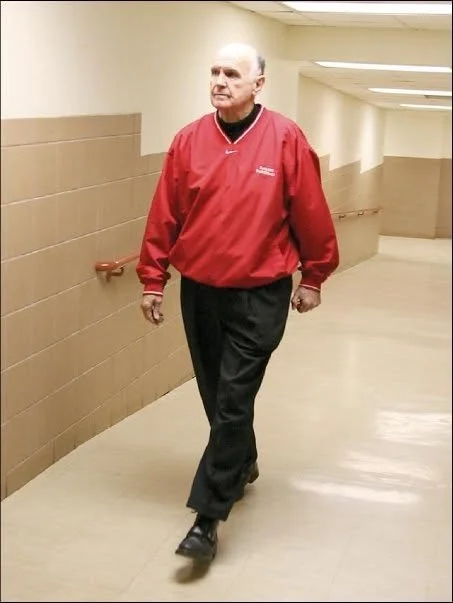
Coach Lewis Orr walking the halls at Navarro College- always with purpose.
Before I begin telling Coach Lewis Orr stories, you need to understand who was sitting across the table from me that morning in 1993.
Lewis Orr was not simply an old Texas coach with a few good stories. He was a first-ballot inductee into the NJCAA Basketball Hall of Fame. He coached for 37 years in Texas junior colleges, including 32 at Navarro College, and won 678 games. His Navarro teams reached the Region XIV Tournament 23 times. The court inside the Wolens Special Events Center fittingly bears his name.
That résumé establishes his credentials. It does not come close to explaining his influence on so many.
I had the privilege of working for Coach Orr as a young assistant coach at Navarro College. I have spent most of my adult life around outstanding coaches, but he may have possessed the finest pure basketball mind of any of them. He understood the game, understood people and knew how to deliver a lesson that stayed with you long after the conversation ended. He was a man who impacted and changed lives.
Sometimes he delivered those lessons without saying a word.
Coach Orr could teach basketball with almost anything. Most coaches needed a whiteboard, a marker and enough room to draw X’s and O’s. Coach Orr used whatever happened to be within reach and was ready a a moments notice to discuss his latest inbounds play or breakdown the triangle offense.
His standard equipment was five pennies he kept in his pocket, each marked with Liquid Paper and numbered one through five to represent the five positions on the floor. Give him those pennies and a flat surface, and Coach could explain practically every offense ever invented. He would break down the action, the defensive choices, the counters and then the counters to the counters.
It was masterful.
Unfortunately, I was young and dumb enough to occasionally believe my basketball mind belonged in the same conversation.
It did not.
Youth is a wonderful thing. It gives you energy, confidence and the remarkable ability to be completely wrong without feeling the slightest hesitation.
One morning, we were eating breakfast in the Navarro College cafeteria. The meal ended, and Coach Orr began talking basketball. That was common. Breakfast might have been over, but class was just beginning.
His pennies were apparently unavailable that morning, so he recruited the salt and pepper shakers from our table and several nearby tables. They were the standard cafeteria variety—about three inches tall and built to survive years of abuse from hungry college students.
Coach arranged them across the table and began demonstrating an offensive set.
He moved one shaker, repositioned another and explained how the defense would react. Every movement forced a decision. Help one way, and the offense got a layup. Help the other way, and somebody was left wide open.
Then he looked at me and said, “Coach, you can’t defend this play.”
His comment should have ended the conversation. What I failed to understand was that Coach Orr was making a statement. He was not soliciting my opinion.
Coach had spent decades studying and teaching the game. He had forgotten more basketball than I would ever know. I was a young assistant who did not yet understand how much I had left to learn.
But I was not about to let experience, wisdom or common sense interfere with a perfectly good argument.
“I guarantee you I can defend it,” I said.
Coach reset the shakers and patiently explained why every defensive adjustment opened something else.
“Coach,” he repeated, “you can’t defend it.”
I had two choices. I could acknowledge that Coach Orr understood the situation better than I did, or I could double down.
Naturally, I doubled down.
Coach began the play again. As he moved one of the salt shakers into position, I reached across the table, grabbed the large glass sugar shaker and planted it directly beside the smaller shaker.
The size difference told the whole story. I had not discovered some brilliant defensive adjustment. I had wandered onto a battlefield where I was badly outgunned and responded by dropping a refrigerator on the opposing point guard.
“There,” I said. “I defended it.”
Technically, I had.
The offensive player was not going anywhere. My scheme required crushing him beneath cafeteria equipment—probably even considered a foul by the Detroit Piston Bad Boys of the day—but the play had been stopped.
Coach Orr looked at me with the disappointed expression of a father whose son has just wrecked the family car. I had seen that look from my own father a time or two, so I recognized it immediately.
Coach did not argue. He did not laugh. He did not tell me I was an idiot, although the evidence was sitting directly in front of him.
He just looked at me.
Then, without saying a word, Coach began picking up the salt and pepper shakers one at a time. He returned each one to the table from which he had borrowed it, handling every shaker with the same deliberate care.
One shaker returned.
Then another.
Then another.
When every salt and pepper shaker was back where it belonged, Coach Orr looked at me once more. Then he walked away.
He left the sugar shaker sitting alone in the middle of the table.
It suddenly looked awfully lonely. There was no one left to guard, and Mr. Sugar Shaker looked hopelessly out of place.
So did I.
There we sat—one young assistant coach and one oversized sugar shaker—left to contemplate the wisdom of a defensive adjustment that had, in fact, stopped Coach Orr’s play.
I had stopped the play.
I had also lost the game.
Coach Orr never said another word about it. He did not need to. Silence, when used by someone who understands timing, can be a remarkably effective leadership tool.
Nothing was broken or bruised that morning except my ego—and my illusion that I was the smartest person at the table.
Coach Orr was trying to teach me basketball. I was trying to beat Coach Orr.
Those were not the same objective.
My mistake was not questioning an idea. Good assistants should ask questions. Honest disagreement can make everybody better.
My mistake was allowing the need to prove myself to become more important than the opportunity to improve myself.
That happens in locker rooms, staff meetings, boardrooms and families. Pride quietly changes the objective. We stop listening to understand and start listening for an opening. We quit trying to solve the problem and start trying to win the room.
Accountability begins when we recognize that pride has taken control.
Responsibility is what comes next.
Accountability says, “I was wrong.”
Responsibility asks, “What will I do differently?”
An apology without adjustment is just a speech. Repeatedly admitting the same mistake without changing is merely commentary on your own bad habits. If experience does not change our behavior, we did not learn from it. We merely survived it.
The final lesson may be the hardest: knowing when to speak and when to shut up.
Leadership requires confidence. There are moments when silence is cowardice—when a bad decision must be challenged, someone needs defending or the truth needs to be said plainly.
But speaking is not always courage, and silence is not always weakness.
Sometimes we speak because the moment requires it. Other times we speak because our ego cannot tolerate somebody else having the final word. Wisdom is knowing the difference.
Kenny Rogers built an entire song around knowing when to stay, when to leave and when to run. That advice applies to much more than cards.
Every argument carries a cost. Before pushing all your chips into the middle of the table, you had better decide whether the point is worth winning. You can prove your point and damage the relationship. You can win the moment and lose something far more valuable.
Coach Orr understood that.
He could have embarrassed me. He could have reminded me of the difference in our experience. He could have dismantled my argument and made certain everyone in the cafeteria knew who had won.
Instead, he quietly returned the shakers and walked away.
That was not surrender. That was command.
He understood the room, the relationship and the moment. His silence forced me to hear what my pride had been drowning out. By refusing to continue the argument, he made the lesson impossible to escape.
Sometimes leadership requires a speech. Sometimes it requires confrontation, correction, patience or forgiveness.
And sometimes it requires carefully returning a few salt and pepper shakers to the tables where you found them, looking at a young assistant coach who still has much to learn and walking away without saying a word.
Coach Orr knew when to leave the table.
I stayed behind with the sugar shaker.
My defense had stopped his play.
But Coach Orr had won the game and even more importantly had taught me a lesson on accountability, leadership and timing.
That morning was only one of the many times Coach Orr taught me something that reached far beyond basketball. I will share more of those lessons in the installments ahead. I hope you enjoy reading them as much as I enjoy remembering the man who taught them.